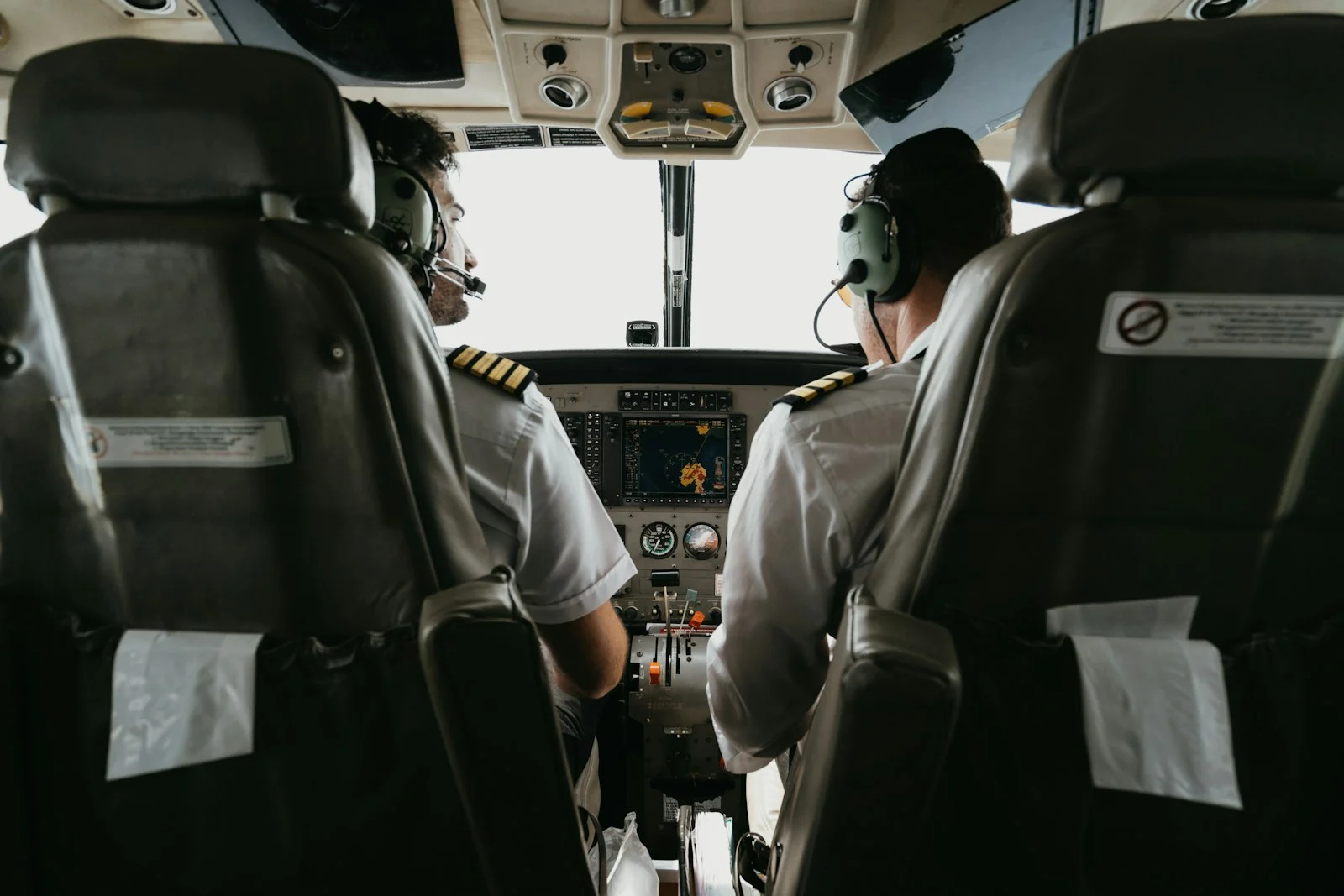
ICAO Level 4 is the minimum a pilot needs to fly internationally, and Level 5 is the next step up. This post follows a first officer through the five hurdles between the two levels and gives the published data behind each one.
Four Level 5 scores and an ICAO Level 4
He flies for a regional airline on a European licence. His last score sheet read: pronunciation 5, structure 4, vocabulary 4, fluency 5, comprehension 5, interactions 5. Assessors award the lowest of the six as the final level, and a high score in one descriptor cannot compensate for a low one.¹
Four fives bought him nothing.
He has company. EUROCONTROL counted 703 flight crew who completed its ELPAC test between January and mid-June 2026. Of those, 312 came out at Level 4 and 200 at Level 5.¹
The prize for moving up is time. EASA makes a Level 4 holder sit the test again every four years and a Level 5 holder every six.² ICAO recommends three years and six.³ The two bodies disagree about Level 4, so he checked which rule his own authority applied before he spent any money.
Hurdle one: he had been training the wrong descriptors
For a year he listened to live ATC feeds and worried about his accent. Both descriptors already stood at 5. He found that out only when he saw his six scores written down, and the weakest descriptor sets the rating.
A study from Vilnius Tech, published in 2023, shows how ordinary his profile is. A certified examiner rated 104 final-year piloting and air traffic control students on the ICAO scale. For comprehension, 89.4% reached Level 5, and for pronunciation, 87.5%. For structure the figure fell to 33.6% and for vocabulary to 39.4%. Only 22.1% reached Level 5 overall.³
FAA researchers found a different problem on live frequencies. Prinzo, Hendrix and Hendrix analysed 4,816 pilot transmissions at five US en-route centres for a 2008 report. They found that pronunciation and fluency lay behind the communication problems of foreign crews whose first language was not English.⁴ The Vilnius authors admit that their students talked to one assessor they already knew. I read the two results as measurements of different things. Examiners in an interview hear every grammar slip, and controllers on a busy frequency lose time to an accent. His test was an interview.
Hurdle two: basic grammar that holds under pressure
He assumed Level 5 meant conditionals and the passive. The rating scale says otherwise. A Level 4 speaker controls basic structures usually and a Level 5 speaker controls them consistently. The Level 5 descriptor still allows errors in complex structures.⁵ One adverb separates the levels.
ICAO's training recordings include a candidate tested on 2 September 2005. Her raters gave her 4 for pronunciation and structure and 5 for the other four descriptors, one of them provisionally, and they wrote that the two weak areas undermined a performance that succeeded elsewhere. The slips they logged were small: a plural "s" on "feet" at 03:16, a past-tense ending after "didn't" at 01:41.⁶
So the first officer shut his advanced grammar book. He recorded incident stories on his phone in the plain past tense and counted his slips per minute.
Hurdle three: paraphrase that works every time
He had the same problem with vocabulary. The scale expects a Level 4 speaker to paraphrase successfully often and a Level 5 speaker to do it consistently.⁵ Anglo-Continental's published notes on a sample TEAP candidate show what that costs. He scored 5 for pronunciation and 4 for everything else, and his raters held vocabulary at 4 because his paraphrasing was inconsistent.⁷
The first officer's drill was crude. Each day he picked one aircraft part whose English name he did not know and explained it aloud for twenty seconds without stopping. He took his opening phrases from the eight phrases worth owning when phraseology runs out.
Hurdle four: how long ICAO Level 4 to Level 5 takes
I have found no study that measures it. The nearest figure comes from Elizabeth Mathews, the linguist who advised ICAO on its language requirements. She put the minimum at 100–200 hours of training to lift a mid-to-high Level 3 to Level 4, and she wrote that such figures stay estimates until aviation programmes publish their own research.⁸ On this site I quote three to five months at two lessons a week for the step from 4 to 5. That is my estimate as a teacher, and no study stands behind it.
The first officer took two lessons a week for twenty weeks and drilled alone for thirty minutes on five other days. That comes to forty hours with a teacher and fifty without. His days off changed with every roster, so he booked the lessons one roster period at a time.
Hurdle five: the test itself
Part of his result lay outside his control. Charles Alderson of Lancaster University surveyed aviation English test providers for a 2010 paper in Language Testing. Twenty-two replied, and he concluded that several tests then used for licensing gave little ground for confidence in their reliability or validity.⁹ Henry Emery reviewed 33 commercial providers in 2017 and found none that published substantive evidence of quality.¹⁰ EUROCONTROL now posts a validity argument for ELPAC.¹ I have not found a survey later than Emery's, so I cannot say how the other tests compare today.
A test's format can also cap a score. ICAO's raters judged one 2005 candidate's comprehension consistently accurate and still held it at 4, because the test format gave him no range of accents and no unexpected turn of events to deal with.¹¹ Before he booked, the first officer asked his test centre which tasks fed which descriptor.
The retest
Twenty-one weeks after he first saw his six scores, he sat the test again. Structure and vocabulary came back at 5. His other four scores remained the same.
If you hold a Level 4 and cannot say which descriptor is keeping you there, a full speaking report marks all six in writing for £59. You record it on your phone in your own time, and the report names the things to fix.
References
- EUROCONTROL. Results, re-sits and appeals. ELPAC portal. Score distribution from ELPAC operational data, January–June 2026, as of 15 June 2026. Accessed 7 October 2026.
- European Union Aviation Safety Agency. Reassessment of language proficiency. FAQ 142108, last updated 23 June 2025. The UK Civil Aviation Authority applies the same four and six years: English language proficiency testing and flight crew licensing.
- Masiulionienė, G. and Tupčiauskaitė, G. (2023). Bridging the gap between ICAO level 4 and 5 in Aviation English: expectations and results. Aviation, 27(3), 197–211.
- Prinzo, O.V., Hendrix, A.M. and Hendrix, R. (2008). Pilot English Language Proficiency and the Prevalence of Communication Problems at Five U.S. Air Route Traffic Control Centers. Report DOT/FAA/AM-08/21. FAA Office of Aerospace Medicine.
- International Civil Aviation Organization. ICAO Language Proficiency Rating Scale, as reproduced in the training aid ICAO Language Proficiency Requirements: Rated Speech Samples. Copy hosted by the Polish Civil Aviation Authority.
- International Civil Aviation Organization. Rated Speech Samples: test taker 040, tested 2 September 2005.
- Anglo-Continental Educational Group (2011). Sample TEAP candidate: notes on individual descriptors.
- Mathews, E. The Value of Content-based Language Training for the Aviation Industry. Paper for the Second ICAO Aviation Language Symposium (IALS-2), Montréal.
- Alderson, J.C. (2010). A survey of aviation English tests. Language Testing, 27(1), 51–72.
- Emery, H. (2017). Commercial aviation language testing: barriers to success? A case study. International Civil Aviation English Association Workshop.
- International Civil Aviation Organization. Rated Speech Samples: test taker 009, tested 11 March 2005.